


Chamonix, France
Updated: Aug 11
The Mountains at the Heart of the Haute-Savoie with Jean-Michel Poupart

The Mont Blanc Valley is so amazing we decided to do our first video podcast - we hope you enjoy it. Chamonix is in the French Alps just north of Mont Blanc, and about an hours drive south of Geneva. Between the peaks of the Aiguilles Rouges and the Aiguille du Midi, it borders Switzerland and Italy and sits at the foot of Mont Blanc. It is one of the oldest ski resorts in France. AND Chamonix has some incredible skiing as well as history going back to Napoleon.

Jean-Michel Poupart lives in the Chamonix Valley with his family and two dogs. Jean- Michel has been a skiing instructor for 20 years in Chamonix he also specializes in off piste guiding; as a Mountain Leader member of the Compagnie des Guides de Chamonix, he knows the mountain and the town.
Chamonix Is Not Just One Ski Resort
One of the first things to understand about Chamonix is that it doesn't operate like a conventional mega-resort. The Chamonix Valley stretches roughly 20 kilometers, with several villages and ski areas spread throughout it. Most days, you'll take a gondola or lift from the valley floor and head above the treeline before your skiing really begins.
At one end of the valley is Les Houches, a lower, more wooded ski area that is particularly useful on stormy days or when avalanche conditions make higher terrain less attractive.
Closer to Chamonix itself you'll find Brévent–Flégère, known for its sunny slopes and spectacular views across the valley toward Mont Blanc.
Then comes Argentière, where the skiing moves into higher, more serious mountain terrain.
Finally, at the far end of the valley is Le Tour, near the Swiss border, offering generally easier terrain but still with plenty of variety.
The Local Secret: Follow the Sun
One of the great advantages of skiing Chamonix with a local guide is understanding something that doesn't show up on a trail map: Snow changes.
Jean-Michel, who has lived in Chamonix for 25 years and has guided clients throughout the region, describes choosing the ski area based on the weather, snow and sun.
In spring, for example, one side of the valley might be icy in the morning while another is beginning to soften into perfect corn snow, later in the day, that equation changes again.
Argentière's west and northwest-facing terrain can preserve colder snow well into late March and early April. Meanwhile, other slopes may become soft or slushy as the afternoon progresses.
The best skiers aren't necessarily asking, “Where is the best run?” They're asking: “Where is the best snow right now?”
Brévent–Flégère: Ski With a View
For a spectacular introduction to Chamonix skiing, Brévent–Flégère is hard to beat.
The eastern-facing terrain gets morning sun, while across the valley you'll see some of the enormous peaks that make the Chamonix landscape so distinctive.
And the mountains here are genuinely unusual; the valley contains three different types of rock — sedimentary, granite and metamorphic — which gives the surrounding peaks different shapes and personalities.
Les Houches: The Bad-Weather Haven
If the weather turns ugly, don't assume the ski day is over, head to Les Houches.
Lower elevations, trees and more moderate terrain can make it a fantastic option when visibility is poor higher up the mountain. The trees provide depth perception, and the slopes are generally well suited to intermediate skiers.
There's another bonus: Les Houches has hosted World Cup racing.
So while it may be the “easy” option compared with Chamonix's legendary high-mountain terrain, don't confuse easy with boring.
For intermediates, it can be one of the most enjoyable days of a Chamonix ski trip.
At the top, you'll find a plateau with a number of blue runs, plus a beginner area with a moving carpet and small chairlift. And even on an easy ski day, the views remain spectacular.
Argentière: The Place to Be When Winter Turns to Spring
If you're visiting Chamonix in late season, put Argentière high on your list.
Much of the terrain sits between roughly 2,000 and 2,700 meters, helping it retain good snow when lower parts of the valley are beginning to feel like spring.
Jean-Michel particularly likes Argentière in late March and April.
The resort stays open until May 1, which is relatively late by European standards, and the higher terrain can offer excellent skiing while lower slopes are becoming softer.
This is also where the Chamonix philosophy really comes into play- If one side of the valley isn't skiing well, move.
Then There's the Vallée Blanche
No discussion of skiing in Chamonix is complete without the legendary Vallée Blanche.
Accessed from the Aiguille du Midi, the Vallée Blanche is one of the world's most iconic high-mountain ski descents.
This isn't a groomed ski run. It's an off-piste glacier journey and you need to go with a high mountain guide. You start at approximately 3,800 meters — around 12,000 feet — surrounded by some of the highest mountains in the Alps. From the top, the descent follows one of several main routes through a massive glacial landscape.
At the summit, you may need to put on crampons and walk along a narrow ridge before reaching the point where you can put your skis on. Your guide ropes the group together and provides the appropriate glacier and safety equipment.
Who Should Ski the Vallée Blanche?
There are routes for different levels, but even the easier routes require solid skiing ability.
Jean-Michel describes the minimum as an intermediate-plus skier, because the snow can change dramatically. You might feel like an expert in one section and suddenly feel like a beginner when the surface changes. There are more demanding routes for advanced skiers and a steeper option for experts.
A mountain guide is essential.
The glacier contains crevasses, the weather can change and while incidents are rare, the risks are real. Skiers are equipped with harnesses and other safety gear so that guides can respond if something goes wrong. The descent is long, spectacular and physically demanding; it's also unforgettable.
The Vallée Blanche Is About More Than Skiing
One of the charming details of the Vallée Blanche experience is that you don't simply take a run downhill.
You stop.
You take photographs.
You look around.
You eat.
There's even a mountain hut where skiers can stop for something warm, often involving the classic Alpine combination of potatoes, cheese, bread and bacon.
The descent can take several hours depending on conditions, route and stops, and most trips finish around the Mer de Glace before transportation brings skiers back toward Chamonix.
When Is the Best Time to Ski Chamonix?
If you want the best snow, January and February are hard to beat.
But March can be amazing, by spring, the days are longer, the sun is warmer and experienced off-piste skiers can take advantage of changing snow conditions.
Fresh snowfall can deliver winter powder, while sunny days can produce beautiful spring snow. The trick is knowing where to go and that's why local knowledge matters so much in Chamonix.
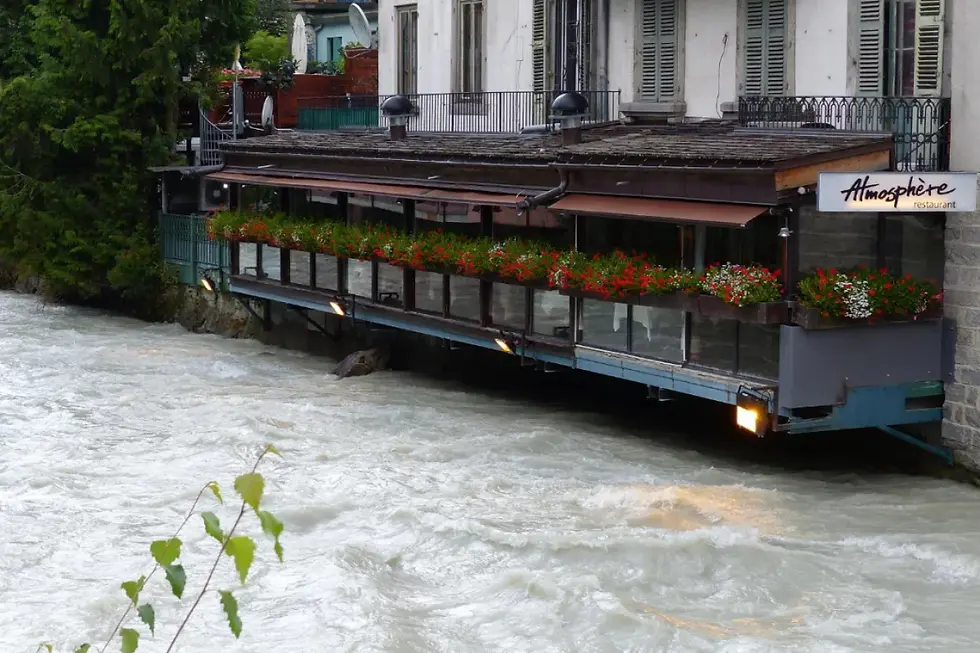
Chamonix Is a Town, Not Just a Resort
Chamonix has a long history, with architecture dating back into the 19th century, traditional bars and restaurants, shops and a distinctly cosmopolitan atmosphere. Its location near Geneva means it can get busy, but that's also part of its appeal. You can ski some of the wildest terrain in the Alps during the day and then walk into town for dinner, drinks and French Alpine culture at night. One local favorite mentioned by Jean-Michel is Atmosphere, located beside the river and offering a mix of French and international food in a pleasant setting.
Our Favs:
Best Restaurant - L'Atmosphere - sitting over the river this one is comfortable and exquisite
Best Apres - Moo - any place that has a tag line of "Walk In, Dance Out" is right up our alley
Best Run - well lets just say the Vallee Blanche is a bucket list run . Choose your day, choose your guide and go
Find Jean-Michel - https://www.skichamonix-megeve.com/
La Compagnie des Guides de Chamonix - https://www.chamonix-guides.com/fr
Episode Transcript
Jean-Michel, thank you for joining us today. I'm excited to talk about Chamonix. Chamonix is an older town concentrated into a narrow valley.
My first feeling was being totally odd seeing Mont Blanc towering over the town and realizing the mountaineering and the skiing history there. Aside from the physics, what brought you to Chamonix in the first place and why do you stay? Yes, it's an amazing place and when you arrive there the first time, you think first, I was thinking first, I might stay long there. So I'm staying there for 25 years.
I think the first reason is just the place, the mountains are huge, they are very different, they all have characters and that's it. The mountains are spectacular when you pull into that valley, it's amazing. Maybe you can give our listeners a little bit of an overview of just that, what you see when you come in the valley and what to expect when you get there.
The skiing is not all centered in Chamonix, it's spread out all over the place. All the way from Argenteuil down to Les Roches. They all have different characteristics, the town is sort of focused on it, but the skiing itself is way up above.
Yes, you're right. Chamonix Valley, so there is a few villages, a town, let's say that Chamonix is a little town and you need most of the time to take a first gondola and then to arrive above the treeline and then you start skiing. At the entrance of the valley, first there is Les Roches.
Les Roches is a more woody area, a bit lower, a bit more family area. It can be a good refuge for the stormy day or if there is a high risk of avalanche, we all finish at Les Roches. It's a kind of joker.
And then after, if you enter more into the valley, first above Chamonix, you have Fléjère-Brévent. Fléjère-Brévent, amazing ski area on the east-facing sun, so in the morning it's really sunny. And you are just watching the high mountains on the other side of the valley.
Mont Blanc, Green Peak, etc., the very high mountains. Then if you go in the valley even forward, then you arrive in Argentière where you will ski on the side of the high mountains. So on this side you can ski higher.
In Grande-Montagne, we could go to 3,300 meters. Unfortunately, there was a fire that destroyed the highest peak, but if you come back in three years, it will be open again. And then we finish at the end of the valley in Le Tour.
There is the border with Switzerland on this ski area. And it's more easy than the two other ski areas, but let's say anywhere on each ski area there is an easy slope, a difficult slope, all kinds of levels. And of course, which is famous, it's off-piste.
Off-piste in Chamonix, you can practice everywhere. Of course, I'm sure you are, maybe we speak about Aiguille du Midi later with the famous Vallée Blanche off-piste, but you can also practice off-piste everywhere in this different ski area. That's a really good overview.
That's a great overview. There are different characteristics for each of the different, almost every different town. Yes, yes, yes.
They are very different. I will say Comansee is difficult to describe, really. But the mountains are very different.
The Chamonix Valley is 20 kilometers long, so in a way there's a whole new change. And so that's good. Every day you change area.
Every day it seems that you are somewhere else. You have different angles of those high mountains. It makes a particularity of Chamonix area.
And you know, also we have many… About geology, we have three kinds of rocks here. We have all kinds of rocks that exist on Earth. You have sediment, you have granitic, and you have also metamorphosed rocks.
So it's all mixed in this region. So if you are watching panoramically, the mountain doesn't look the same. It's really particular.
I didn't travel outside Europe so much, but in Europe it's one of the best places, I would say, in Alps for this. So that must make it really interesting in the summer for climbing too. And of course, in summer for climbing, in granite, the granite is very pure.
It's very pure. The cracks, I say in English, the cracks are very interesting. People can put their device in the cracks and climb.
It's not a big wall like in the States. I'm sure it's still challenging, more challenging than I want to tackle. And also there is hiking.
In summer, you have all these high mountains to climb, but also all these high mountains where you can hike. You can hike one day, you can hike a few days in a row. There is a mountain hut in the mountains, you can sleep.
You can have dinner or breakfast and you can sleep there. The next day, you go ahead. There is a famous tour.
We are speaking about Mont Blanc. There is a Mont Blanc tour. You go around the range of mountains in 10 days.
If you are not cheating with a transfer in a van, you can do five, six days in three countries. I think one of the particularities of the area also is that we are in three countries. There is Italy and Switzerland very close.
There are three cultures. You have three types of wine, you have many types of cheese. I've heard of that 10-day trip around.
It's supposed to be spectacular in the summer. It is. Again, I will tell you that every day is different.
I tell my clients, because you asked me, people want to know before they come. You say, we will speak again in 10 days. I tell you that you will feel like every day will be different.
It's okay. They agree at the end. It's something.
This is why I did this tour, I imagine, almost 100 times. I'm doing this for 25 years. If I do it four times a year, it's 100.
I'm not getting bored because of this. It's different every day. Of course, it's different.
My clients are different. Also, there is a strong variety. It changes every day and probably changes every year.
Let's go back to skiing. No discussion of Chamonix is complete without talking about the Aiguille du Midi and Valais Blanche. That's probably one of the most iconic pieces in the world.
What makes it so special? First, it's not a piece. It's an off-piste. Fair enough.
It's an off-piste. There is no market piece on the side. There is one valley.
There are four main routes, which make it particular. It's the surrounding mountain. You start at 3,800 meters.
Sorry for Americans. It will be 12,000 feet. Something like this.
You will make the correction. 12,000 feet. You have the Mont Blanc.
14,000-15,000 feet around. You are going down this valley. It's a very high, steep mountain on the side.
It's a huge glacier. When you are starting at the top of the glacier, there is the first plateau. There is more than 400 meters deep of ice.
Imagine. Before this plateau, you start on a ridge, on a sharp ridge. On one side, you have Chamonix.
1,500 meters vertical down on the left, which is very impressive. Just because of this, you will remember it. You won't forget the beginning.
Then, you will start skiing. Of course, with a high mountain guide. You will feel secure.
You will feel in security. You will follow the guide. As I said, there are four main routes.
There is a route for intermediate skiers. Intermediate, let's say, plus-plus, because you will meet all kinds of snow. When you are intermediate, in certain snow, you feel like being a beginner.
It's better to be intermediate plus-plus to be able to still enjoy your trip. We can say a trip in this long valley. There are four main routes.
There are two other main routes with maybe a bit steeper, a bit in the middle of the cracks. In French, you know, big holes like this. There are certain routes a bit more demanding technically.
You need to be able to stop quickly, to turn quickly, to just go where the guide is going. It's more for advanced skiers. There is one route with a much steeper route for experts.
There is for everybody. We used to say it's 16 kilometers long from the top to Chamonix. To Chamonix, it's a bit rare that there is a condition to reach Chamonix.
Most of the time, you are ending at a place called Mer de Glace, where there is a coke train to bring you back. First, you take a little gondola. You know, the glacier with the global warming is shrinking, shrinking, shrinking.
So you go up to meet the train. You have a gondola now. In summer, you have stairs plus a gondola.
Now you have a gondola, and it's really brand new this year. They opened a new one. I was going to ask about that.
Does that help? I know that getting out of there, you used to have to go up a lot of stairs, like 500 stairs. 500, 700, maybe. Every year, it's more.
50 stairs more per year. Actually, they just opened a new one. Now, if you get this option to not go skiing to Chamonix because there is a lack of snow, you won't have to go upstairs now.
But next year, there will be 30 stairs. In two years, there will be 50. In 10 years, there will be... What's it like going off the ridge up there at the top? You have to put... A lot of times, you have to put on crampons and walk down the ridge to be able to drop into any of the four routes.
Well, yes. I assume that's a little... That's not the usual, you know, wearing crampons and then hauling your skis down the ridge. But once you get there, you put your skis on and you just drop in and work with your guide? Yes.
You're right. It's an experience to get all these gears. First of all, at the bottom, in Chamonix, the guide will give you a harness.
You need to wear a harness on a glacier. It's not because you will climb. But if it happens that you finish in a hole, which is very, very, very, very rare, but if it happens, it's a possibility that it happens.
For the rescue people to get you, it's much more easy. Then you will have... And when you arrive at the top, there is a tunnel in the rocks. There is a terrace outside, but there is a tunnel in the rock.
And in one of the tunnels, you arrive in the snow on this special ridge. And there is also an ice cave just before you are leaving this place. It's a very, very amazing place with blue ice.
Then the guide will put you on a rope altogether and he will give you crampons to put on your foot. And then you go outside and you go hiking on this ridge. Most of the time on the ridge, there is also an extra rope.
And there is also... How do you call this in English? Like sticks. Sticks in the snow with a rope. And you can hold it.
In fact, there is two routes. One without, one with. So if the guide, if you are five, six with the guide, maybe he takes the route with the rope.
If not, he's holding you with the rope and you go more straight to the place to put on your skis. But it lasts 20 minutes, I would say. It's quite impressive.
But it's all in security. It's all in security. No, no worry.
So I would say, agree du midi, you can also go just for the view. Most of the people are going there for the view, even in winter. Of course, in summer there is much less people leaving this area to go in the high mountains because it's really mountaineering and you need to be skilled.
But also in winter, people just go for the view, it works. So that's an all-day trip too, isn't it? That's like two or three hours minimum going up and down. You're right.
In real skiing, let's say it's two hours. But you have a lot of stops just to watch where you are, speaking with the guide where you are, you make photos, you eat something. You can also have a break halfway down.
There is a mountain hut halfway down. Usually people are sleeping there in summer to go climbing, but in winter it's open for the skiers on the way down. So you can have a little something to eat, something warm.
Most of the time, based on cheese, something a bit heavy, to give you energy. Potatoes, cheese, bread, bacon. What's the right time to ski that? You must have pretty good weather to be able to ski that.
You need the visibility, you need the depth perception. Of course. Of course, it's one of the first things to have the visibility.
It can happen that the guide can't sell. Just a few clouds. The guide knows well the area, but sometimes also they say, OK, let's go, but they can't sell at the top.
There is too much risk. Also to answer, the best period, 30 years ago we were doing just this from February, but now if the conditions are good, it could be in December. As long as the glacier is a bit, the holes of the glacier, the crevasses are a bit filled by the snow, there is a bridge.
You can do it until the end of April. Really? It's a kind of spring ski. Cool.
I didn't know that. Aside from the Vallée Blanche, you were talking about Argentière and the skiing up there, and there's some really good skiing. How is that ski? That faces more toward the west, so you get afternoon sun.
Exactly. Afternoon sun, December, almost no sun. It's just half an hour.
Now it's getting more and more. It's west, northwest, so most of the slopes are between 2,000 and 2,700, so it's keeping very good snow, a bit cold. Late March, beginning of April, you still have good snow there.
This is why I come back to the choice where you ski every day. Me, with my client, it depends on this. OK, we are in spring, there will be sun this morning on this side of the valley, so let's go there.
The snow will get very good to ski around 11, and it's still cold, so we can maybe spend the day there. If not, we will change the area, going somewhere else in Argentière for this snow. At the end of the valley, you have Le Tour, or it's in the shade on one side in the morning, then it's in the sun on one side in the morning, then it's in the sun in the afternoon.
So when it's slushy on one side, it's better on the other side, etc. So it's really part of my job to choose the right place or to be in the right area. How do you get up the road on there? Are there buses periodically? Transportation is usually pretty good around there, but rent ski areas.
Do they have buses that go up, or is it skiable to get up there? I don't think so. The ski areas are not connected, so you can't take buses. Now the network is getting better and better.
With global warming, we think that we should be an example because the first impact is on the snow, and one of the impacts is the snow. It's in the mountains, so the valleys, the town halls, they make this getting better and better, and to push people to get the bus, the parking is shrinking and shrinking and shrinking, and they are more expensive, expensive, expensive. So this is the reality.
So don't be scared to spend your day on the bus. Usually you choose, we go on one ski area, and then we spend the full day on this ski area. There is enough for every day.
But sometimes, anywhere, with my client, or if you are four or five people, we get the car. We can also, anywhere, drive, still drive in the valley. So Les Hoches is where I've skied the most in Chamonix myself, and it's not so high.
It's further down. There are trees, so that you get depth perception in bad weather, like you were talking about earlier, and the runs aren't incredibly steep. It's more geared toward intermediates.
They also hold the World Cup races there, correct? Yes, correct. It was two weeks ago, there was Slalom, Slalom Men World Cup. There was also downhill, but it was cancelled at the last moment because it was too warm.
During one week, it was too warm, and the snow won't be good for this level of skiing. A racer like this, if the snow is not like ice, it's not good, it's not fair. For example, the other one behind, they will ski on the rail, so now they cancelled.
But it was a nice World Cup, kind of hard today, of this World Cup. For many years, we didn't have a good skier, a French good skier. There was a favorite with French, but they cancelled.
You've got a couple of good French skiers now in all the disciplines. What's the best place for intermediates, say, at Les Hoches, to ski? If you were to take a client there, where would you take them? If they were good skiers, but intermediates? At Les Hoches, I would say, what's nice when you arrive at the top, at the very top, you take a gondola from the bottom, you arrive at the very top, it's not difficult, it's a kind of plateau. It's not totally flat, but it's a kind of plateau, so there is many blue slopes.
You go first at the top. You are not starting with a small lift at the bottom, then a second lift. No, no.
You go at the top first. Also at the top, there is a beginner area with a moving carpet, a small chairlift. It's rare that you have a chairlift for beginners.
A very small chairlift is a perfect place, a really perfect place to start for intermediates here. And then getting down, so, of course, for more expert people, you can come, but there is better in the valley for them. Anyway, the landscapes are amazing, the mountains are amazing, so even if you spend... Even if you spend one day on an easy ski area, you are still enjoying the place because it's a new view, it's a new panorama.
Maybe you won't come back because you will prefer a steeper slope somewhere else, but you are happy anyway to spend one day in all of these ski areas. So your favorite time to ski Chamonix, if I remember right, is more toward the spring because you get more sun, it's just more fun, the snow is usually better. You're saying spring? Yes.
Is that right? Or do you like in December? Yes, spring, if you just... Spring, the snow, sometimes it's very stashy, it's very wet in the afternoon after 3 o'clock, it's difficult, except in Argentière, except in Argentière, it's rare that it's like this. So, let's say late in season, we ski more in Argentière. You know, Argentière, it's closing the 1st of May, so it's quite late.
In Europe, it's late. Most of the ski resorts, they close beginning of April, mid-April, and it's good for terraces, the sun, the ski bar, but I would say for the best snow, it's still January and February. And I would say March.
March, you have a lot of off-piste skiers because in off-piste, you learn to enjoy all kinds of snow. Sometimes it's paradise because you are lucky, there is fresh snow, etc. But anyway, most of the time, it's very enjoyable too.
When the snow starts on the surface to get things to be smooth on the spring snow, it's very enjoyable too. So, in March, people come also for off-piste. If it's snowing, they have winter, cold snow.
If not, they have this kind of spring snow and they know to be at the right place at the right moment. Most of the time also, they get professional. You know, in Chamonix, we didn't mention it, but there was this story, the first guide company was created there.
So, you have hundreds of high mountain guides, you have hundreds of skiers like me. So, many, many, many people go off-piste with a professional. I know that it's more easy than in America.
Off-piste, I understand, in your place, some places are forbidden, but here, you have a guide to make the security and go everywhere to find the good stuff. It is easier there to go off-piste. It's much easier in a lot of places.
It's getting better here, but again, the guide is the key part. And it's about learning the right places to go and not getting into trouble. All right.
So, Chamonix is unique because it's in France. It's a fun town. It's got some amazing history to it, but it's got great restaurants.
It's got great shopping. It's turned into quite a cosmopolitan town. Even sometimes it's crowded because it's so close to Geneva.
Tell us a little bit about town, what your favorite parts of the town of Chamonix are. Chamonix, the main center, the center is very historic. All things started more than 200 years ago, so you still have the architecture of the 19th century.
It's very nice. You still have a few bars, old bars, restaurants. What's your favorite restaurant? And again, the mountains make the show because then you lift your head and you see all this, so you are on a terrace.
What's your favorite restaurant in town? I don't know if I'm right to answer this. No, I would say I have one which is called Atmosphere. Atmosphere is on the side of the river.
It's on the side of the river. You will find, of course, very good food. It can be French, it can be also from all over the world.
And the service is very nice. Problem of touristic area, sometimes it's difficult to find stuff, so the service is not so good. Sometimes you pay expensive, you don't have the good service.
You pay a bit expensive, the food is quite good, compared to what you pay. But in Atmosphere, it's maybe 10 or 15 euros.


Comments